
Media Backgrounder: Canadian Tourism Industry
Media Backgrounder: Canadian Tourism Industry
Last updated August 2026
Note to editors: This data is current as of August 2026 and reflects the latest revisions to Statistics Canada's National Tourism Indicators.
Economic Impact:
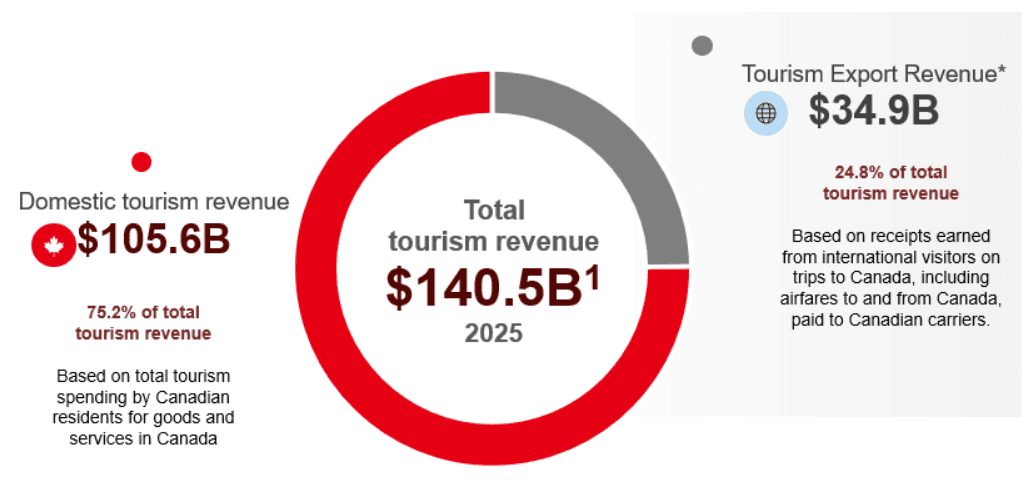
- In 2025, visitors generated $140.5 billion in direct spending, contributing more than $385 million to Canada's economy every day. See: 2025 Tourism GDP Infographic.
- Summer 2025 was a record for Canadian tourism, with domestic tourism as a significant contributor. Destination Canada estimates total summer tourism revenue at $59B.
- Across Canada, tourism supports 280,000 businesses in 5,000 communities.
- 1 in 10 jobs relies on tourism.
Outlook:
- In 2026: tourism revenue is projected to increase by 6% year over year.
- In Q1 of 2026, tourism revenue grew 5.6%, supported by a 7.6% increase in international visitor spending, despite unrest in the Middle East that began in late February 2026.
- As of June 2026, international overnight air arrivals were up 4.2%1
1 Source: Statistics Canada, Leading Indciators year over year, continuing the momentum that began in the second half of 2025.
Tourism is a Top Service Export:
- Every time an international visitor spends money in Canada, that brings foreign dollars into local communities that wouldn’t otherwise flow into the economy.
- Tourism is one of Canada’s top two service exports, with international visitor spending accounting for 14.5% of the country’s total service exports in 2025, ahead of telecommunications and financial services.
- Travel and tourism together represent Canada’s largest service export category, accounting for 30% of all service exports.
- In 2025, international visitors generated $34.9 billion in tourism export revenue for Canada.
- Tourism is projected to contribute 9-10% (up to $30 billion) toward Canada’s goal of securing an additional $300 billion in non-US exports by 2035.
- This is driven by demand from overseas markets, with 9.8% annual growth forecast over the next decade—nearly double the US pace—reinforcing tourism as one of Canada’s top service exports.
Tourism Markets: Destination Canada is Canada’s national tourism organization and promotes the country globally in nine key leisure markets: Australia, China, France, Germany, Japan, Mexico, South Korea, United Kingdom and the United States. These nine markets have the highest concentration of guests that stay longer, explore deeper, and engage with local communities.
- Canadians are increasingly choosing to travel at home, with reshored spending expected to add $1.5 billion in 2025 and $4.4 billion between 2025 and 2027, giving the national outlook an immediate lift across Canada’s 122 tourism regions.
- The United States remains Canada’s largest international market, unmatched in scale, with total US spend forecast to grow 5.3% annually till 2035 as higher-yield air arrivals outpace land and sea travel.
- Overseas markets are the sector’s export acceleration engine, forecast to grow 9.8% annually through 2035, roughly double the US pace, strengthening diversification across markets, seasons and sources of demand.
- Business events remain a high-yield export play, with association events projected to reach 132% of 2019 levels by 2028 and delegate volumes 118%, extending long-term trade, talent and legacy benefits for host communities.
Canada’s Reputation:
- Canada continues to rank among the world's most respected and trusted nations, placing second in RepCore® Nations 2026 and remaining one of the world's highest-rated country brands. It also ranked third in the 2025 Anholt Nation Brands Index. This strong global reputation provides the foundation for Destination Canada's Canada, naturally brand platform, which is designed to convert that strength into travel demand.
- Canada’s global reputation for stability and openness is a powerful competitive advantage, giving travellers confidence and strengthening our position as a welcoming destination of choice.
Media Backgrounder: Canadian Tourism Industry
Last updated August 2026
Note to editors: This data is current as of August 2026 and reflects the latest revisions to Statistics Canada's National Tourism Indicators.
Economic Impact:
- In 2025, visitors generated $140.5 billion in direct spending, contributing more than $385 million to Canada's economy every day. See: 2025 Tourism GDP Infographic.
- Summer 2025 was a record for Canadian tourism, with domestic tourism as a significant contributor. Destination Canada estimates total summer tourism revenue at $59B.
- Across Canada, tourism supports 280,000 businesses in 5,000 communities.
- 1 in 10 jobs relies on tourism.
Outlook:
- In 2026: tourism revenue is projected to increase by 6% year over year.
- In Q1 of 2026, tourism revenue grew 5.6%, supported by a 7.6% increase in international visitor spending, despite unrest in the Middle East that began in late February 2026.
- As of June 2026, international overnight air arrivals were up 4.2%1
1 Source: Statistics Canada, Leading Indciators year over year, continuing the momentum that began in the second half of 2025.
Tourism is a Top Service Export:
- Every time an international visitor spends money in Canada, that brings foreign dollars into local communities that wouldn’t otherwise flow into the economy.
- Tourism is one of Canada’s top two service exports, with international visitor spending accounting for 14.5% of the country’s total service exports in 2025, ahead of telecommunications and financial services.
- Travel and tourism together represent Canada’s largest service export category, accounting for 30% of all service exports.
- In 2025, international visitors generated $34.9 billion in tourism export revenue for Canada.
- Tourism is projected to contribute 9-10% (up to $30 billion) toward Canada’s goal of securing an additional $300 billion in non-US exports by 2035.
- This is driven by demand from overseas markets, with 9.8% annual growth forecast over the next decade—nearly double the US pace—reinforcing tourism as one of Canada’s top service exports.
Tourism Markets: Destination Canada is Canada’s national tourism organization and promotes the country globally in nine key leisure markets: Australia, China, France, Germany, Japan, Mexico, South Korea, United Kingdom and the United States. These nine markets have the highest concentration of guests that stay longer, explore deeper, and engage with local communities.
- Canadians are increasingly choosing to travel at home, with reshored spending expected to add $1.5 billion in 2025 and $4.4 billion between 2025 and 2027, giving the national outlook an immediate lift across Canada’s 122 tourism regions.
- The United States remains Canada’s largest international market, unmatched in scale, with total US spend forecast to grow 5.3% annually till 2035 as higher-yield air arrivals outpace land and sea travel.
- Overseas markets are the sector’s export acceleration engine, forecast to grow 9.8% annually through 2035, roughly double the US pace, strengthening diversification across markets, seasons and sources of demand.
- Business events remain a high-yield export play, with association events projected to reach 132% of 2019 levels by 2028 and delegate volumes 118%, extending long-term trade, talent and legacy benefits for host communities.
Canada’s Reputation:
- Canada continues to rank among the world's most respected and trusted nations, placing second in RepCore® Nations 2026 and remaining one of the world's highest-rated country brands. It also ranked third in the 2025 Anholt Nation Brands Index. This strong global reputation provides the foundation for Destination Canada's Canada, naturally brand platform, which is designed to convert that strength into travel demand.
- Canada’s global reputation for stability and openness is a powerful competitive advantage, giving travellers confidence and strengthening our position as a welcoming destination of choice.